
When I was still in the MICU and heard the news that I would be going to the Medical Step Down Unit (the MPCU), one of my nurses told me about a nurse down there named Deanne who also survived a traumatic health situation. When Deanne was in her early twenties, she was swimming and her heart stopped. They were able to revive her, but unfortunately there were complications and a lot of her circulation was cut off which led to the amputation of one of her legs. Ten years later, her doctors still can’t tell her how or why this happened. Deanne has a prosthetic leg and you would never know unless she told you—and she also had to get a tracheostomy and PEG tube. I couldn’t believe her story and was really excited to meet her, as I was really scared about having the trach and PEG tube procedures and what I would look like after—if I got through it. Hearing someone else’s story really puts things into perspective, and when I heard Deanne’s, it gave me hope that I could come out on the other side.
Deanne was so real with me. Every day someone would tell me to take “baby steps” or “one day at a time.” I had been hospitalized for nearly two months and was so sick of hearing that. The first time we talked, she told me “you are allowed to be pissed—you are allowed to feel sorry for yourself—and you are allowed to ask to be alone.” She told me she was the “worst patient” in the hospital and tried to escape multiple times. Having your leg amputated and almost being able to escape from a hospital is the most badass thing I have ever heard. She made me laugh, cry, and I wish she knew how much her strong mentality helped and inspired me. Her trach scar was visible but not bad at all (I knew she had one so obviously my eyes went straight to it) and she lifted up her shirt to show me the PEG tube scar on her stomach which also wasn’t as bad as I thought. Meeting Deanne and having her care for me was one of the biggest blessings in the hospital and I’m extremely grateful for how open she was about her story.
Around this time (just after Christmas), I was feeling stronger. I was walking again, and that was huge. Grant, Cate and Tess were with me 5 days a week. Since Tess is an Occupational Therapist, we did a lot of “activities of daily living” which consisted of a wide range of things. Anything from range of motion exercises, to getting up, walking to the sink, and brushing my teeth/washing my face/brushing my hair. She also was an amazing friend to me and we would just talk about life, her upcoming wedding, and how her dress shopping was going. My mom was so excited for her and we tried helping with her final decision.
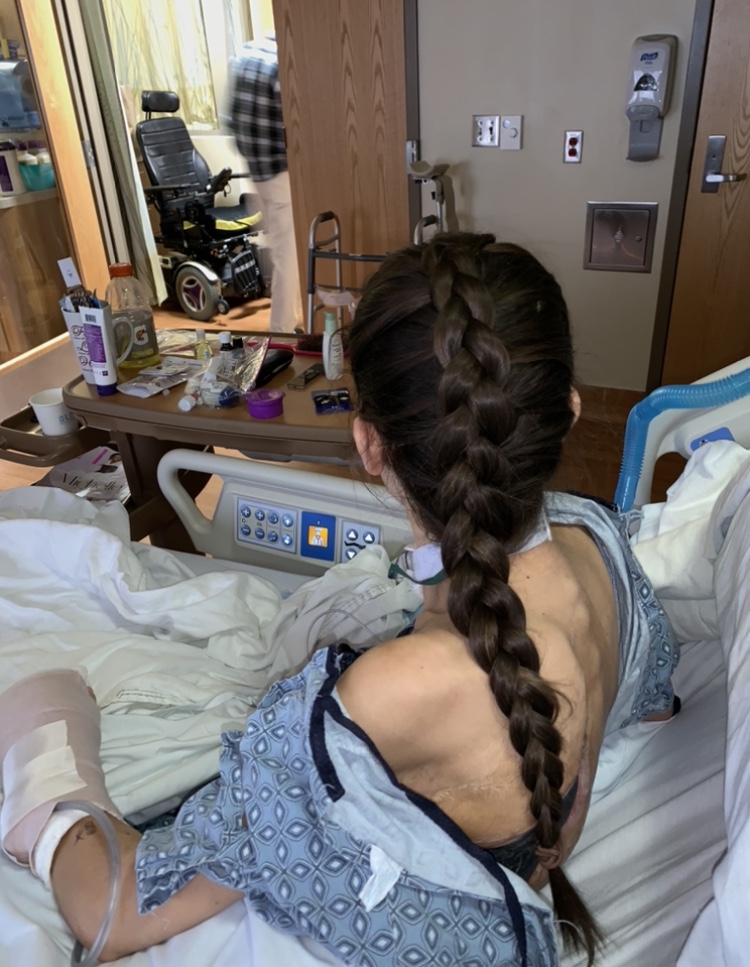
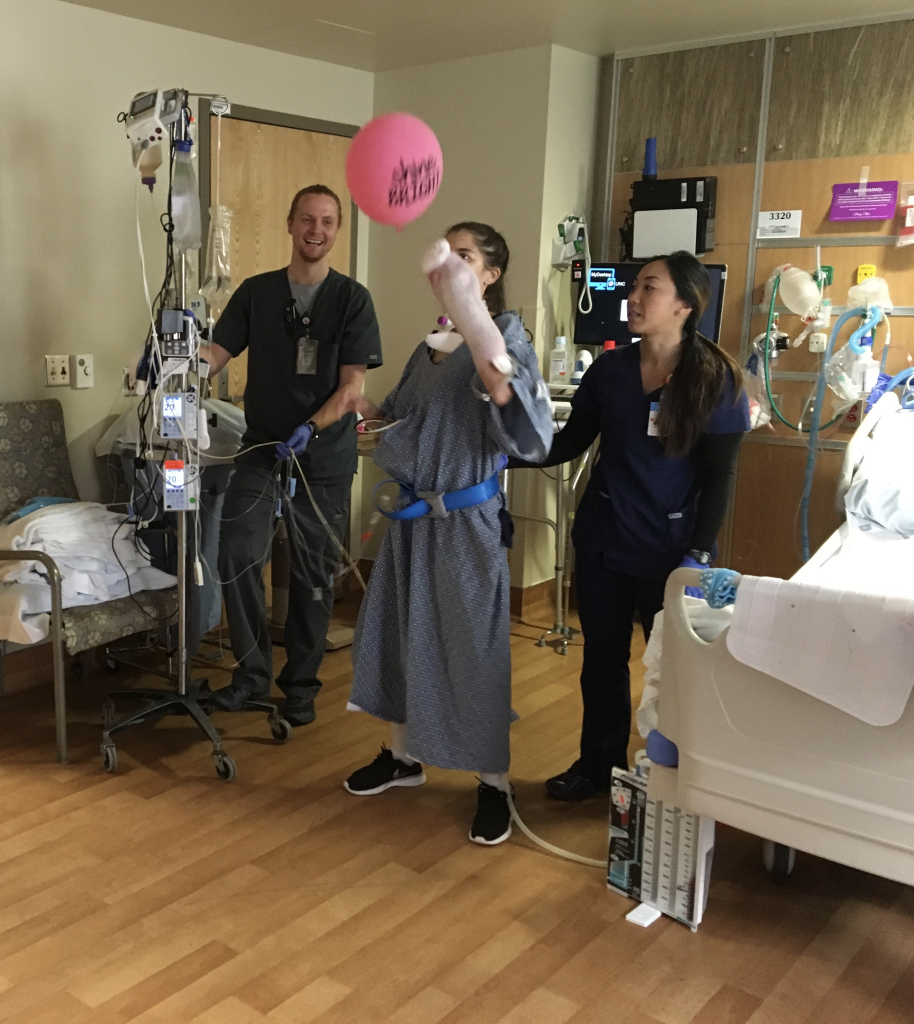
In regards to PT, I was walking, attempting to do squats, and doing any fun activity Grant or Cate had come up with that day. One of my favorite PT memories was tapping a balloon back and forth to work on my range of motion. Since I was glued to a hospital bed and unable to walk for nearly a month, my arms were basically stuck to my sides. I’m still working on it, but it’s gotten a lot better. Now I can effortlessly put my hair up, when during those long 6 months, nurses and NA’s would have to do it for me. A Nursing Assistant named Savannah would braid my hair almost every time she was working. She was 19 at the time and was like a little sister to me.

UNC is a teaching hospital, so I was constantly meeting new doctors and residents. Every morning, new faces would huddle around me to listen to the doctor’s report. Some days I couldn’t stand it. Since my mom and a lot of my friends/family members are nurses, as well as having an Uncle who is an ER Physician, I think that was in the back of my mind, which made me be patient. It was just hard being surrounded by all these new faces when a lot of times they wouldn’t even introduce themselves. I knew they didn’t mean anything by it, but it made me feel even more like a science project. One day after I expressed this to my mom, she asked everyone to introduce themselves before the doctor gave report. It made me feel somewhat better and I finally started to get to know some of the unfamiliar faces.
There was one doctor in particular who made me break down the first time we met (or at least the first time I remember meeting him). As usual, I was smiling, pretending everything was fine, and he came into my room after a wound vac change to tell me his concerns. He told me he had never seen a wound like mine and wasn’t sure how they could fix it, and told me the risks that came along with having Vasculitis/Wegener’s. Again, doctors can’t answer questions like this, but I immediately started crying and asked him if I was going to be okay and what was going to happen to me. He just kept saying he had never seen a wound that size. I hadn’t actually seen it, so that made it even harder, but no one thought it was a good idea to show me, especially because I wasn’t asking. I remember his chief resident trying to comfort me after the doctor left the room, and that was the start of some really positive relationships with the residents on my case.
That same doctor replaced my two chest tubes with one on 12/31/18 and told my family the wound was looking slightly better. That was good news. I tried not to hold grudges against doctors that didn’t give me much hope, because unfortunately a big part of their job is to relay all news, whether it’s good or bad. When you’re sick or injured, you need the truth and there’s no point in sugar coating things. I learned to respect my doctors for being so transparent with me since it was an extremely complicated and confusing situation. I was heavily medicated and was having a hard time understanding the specifics of what was going on with me or how it even happened in the first place.
 Dear Vasculitis